

Aquarium Cleaning Fundamentals Every Owner Should Know
The core mechanics of aquarium cleaning — water changes, substrate care, and algae control — explained simply.
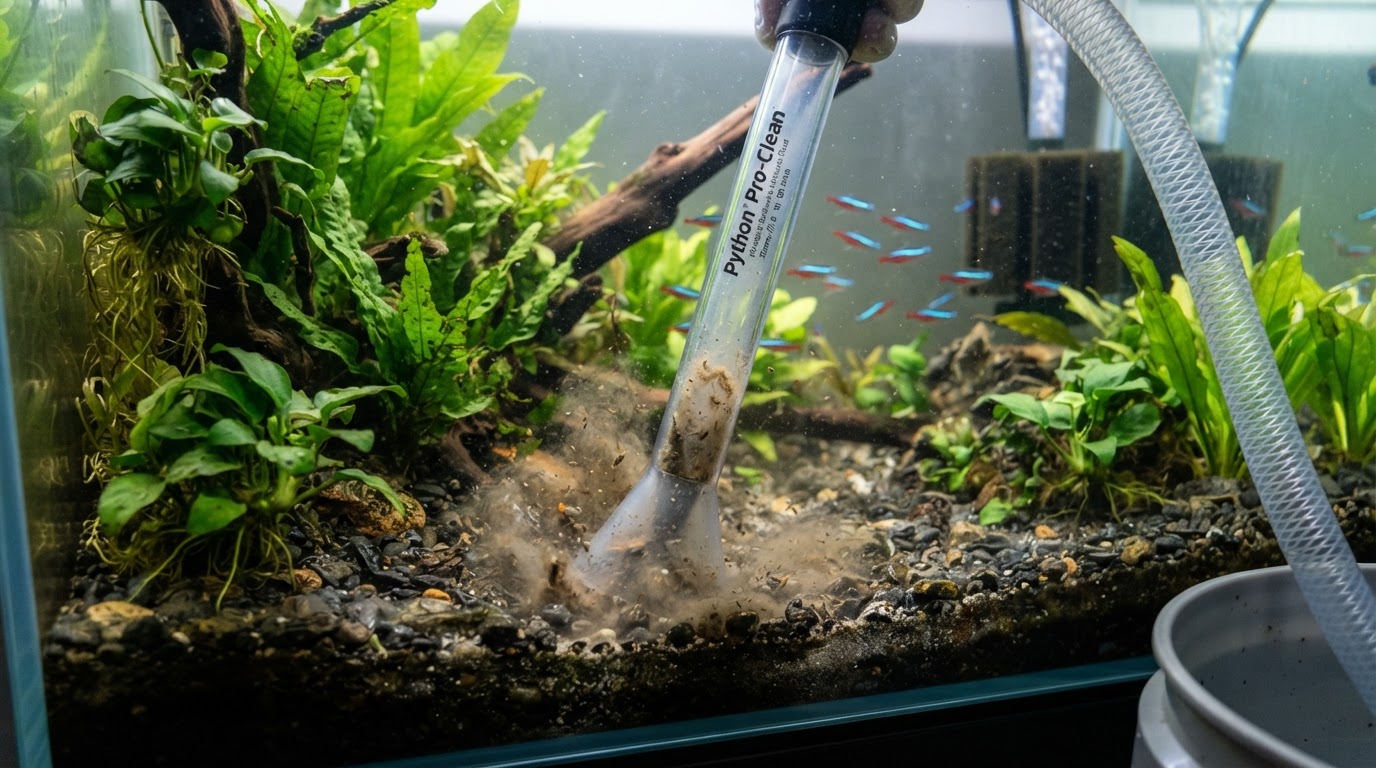
Good aquarium cleaning starts with dilution. A partial water change lowers dissolved wastes faster than any filter can process them, which is why regular exchanges anchor every healthy routine. No filter, however well-maintained, can remove nitrate and dissolved organics as effectively as replacing a portion of the water with clean, pure water on a consistent schedule.
Effective aquarium cleaning also means vacuuming the substrate where uneaten food and fish waste collect, and cleaning panels with non-abrasive pads so you never scratch acrylic or weaken a silicone seam. The substrate is where the majority of detritus accumulates, and a gravel vacuum lifts it before it breaks down into the dissolved wastes that fuel algae and stress livestock.
The goal of aquarium cleaning is stability, not sterility. Preserve beneficial bacteria in your filter media, avoid full teardowns, and clean often enough that small corrections keep the ecosystem balanced. A tank that is constantly torn down and restarted never establishes the stable biological filter that is the real foundation of water clarity and livestock health.
Steady, light aquarium cleaning every week or two prevents the heavy cleanup that stresses fish and destabilizes chemistry, and it is far easier to sustain than a crisis-driven overhaul that strips the biological filter and restarts the cycle from scratch. The owner who cleans lightly and often outperforms the one who cleans heavily and rarely, every time.
Algae control is a function of nutrient balance, not elbow grease. The algae that appears on the glass is feeding on the nitrate and phosphate in the water, and the only permanent solution is to keep those nutrients low through water changes and careful feeding. Scraping algae off the glass without addressing the nutrients that feed it is a cycle that never ends.
Material awareness is a fundamental. Glass tolerates razor blades and stiff pads; acrylic does not. Using the wrong tool on the wrong material is the most common cause of permanent cosmetic damage in aquarium cleaning, and it is entirely preventable by matching the pad to the panel. A dedicated acrylic pad costs a few dollars and saves a viewing panel that costs hundreds.
Recognize that the best aquarium cleaning is the one you do before it is needed. A tank that is cleaned on a schedule never gets dirty enough to require a disruptive deep clean, which means the livestock never endure the stress of a major water change or a torn-down restart. Consistency is the fundamental that makes every other aspect of aquarium care easier and more effective.
Finally, understand that cleaning and maintenance are inseparable. The aquarium cleaning that ignores water chemistry is cosmetic, not fundamental, and the tank whose glass is spotless but whose nitrate is climbing is a tank headed for a crash the cleaning hid. The fundamental approach tests the water, changes it gradually, cleans the equipment as well as the glass, and logs the results so each cleaning builds on the last rather than starting over. That is what separates a healthy tank from a clean-looking one.
Need professional help with residential aquarium maintenance?
Connect with listed aquarium specialists serving residential and commercial facilities.