

Fish Tank Maintenance Basics for New Owners
The essentials of fish tank maintenance — feeding, water changes, and testing — for a healthy start.
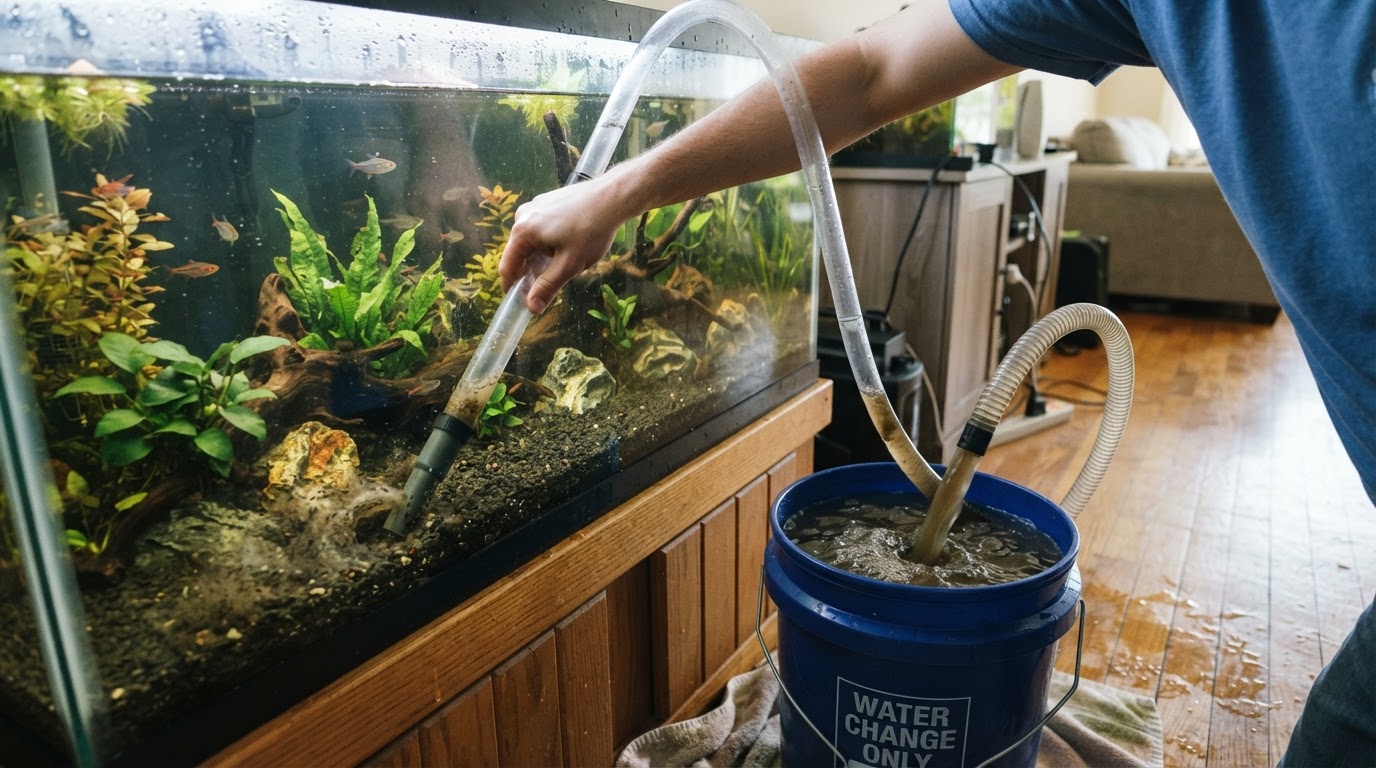
Steady fish tank maintenance begins with feeding only what the fish eat in a minute or two, then testing water weekly so you catch ammonia or nitrite spikes before they harm livestock. Overfeeding is the single most common mistake new owners make, and it causes more water quality problems than any other aspect of care.
The core of fish tank maintenance is the partial water change — typically 20–30% — paired with a substrate vacuum that lifts waste the filter cannot reach. The water change dilutes dissolved wastes, and the vacuum removes the detritus that would otherwise break down into the ammonia and nitrate that stress livestock and fuel algae.
If life gets busy, outsourcing fish tank maintenance to a local specialist keeps the routine intact, which is the main reason some tanks thrive while others struggle. The tank that is cared for on a schedule outperforms the one that is cared for when the owner remembers, and a professional provider arrives on the schedule the owner's life disrupts.
New owners should also treat fish tank maintenance as a logged habit: recording each test result and water change creates a baseline that makes it obvious when something drifts, and it gives any professional you later hire a head start on understanding your system. The log is what turns a series of visits into a running history that reveals trends over time.
Filter care is part of the basics that new owners often get wrong. Rinse mechanical sponges in discarded tank water, never replace all the media at once, and the biological filter that processes ammonia and nitrite survives the cleaning. Tap water kills the beneficial bacteria, and a full media replacement restarts the cycle, which is how a cleaning causes a crash.
Temperature stability is another basic. A heater without a backup, a thermometer that is inaccurate, or a tank near a drafty window all introduce the temperature swings that stress fish and invite disease. A stable temperature is more important than a precise one, and a backup heater is the cheapest insurance a new owner can buy against a cold snap that kills livestock.
Learn to read the livestock. A fish that is eating less, hiding, or breathing rapidly is telling you something before the test kit does, and catching a problem early is the difference between a quick correction and a tank crash. Fish tank maintenance is not just about the water — it is about watching the animals whose behavior reveals what the numbers cannot.
Finally, keep the routine simple and sustainable. The fish tank maintenance plan that fits your life is the one that gets done, and the elaborate routine you abandon after a month is worth less than the modest routine you maintain for years. The livestock respond to consistency, not effort, and the owner who does a little reliably outperforms the one who does a lot sporadically, every time.
Need professional help with residential aquarium maintenance?
Connect with listed aquarium specialists serving residential and commercial facilities.