

Relocating an Aquarium: How Professionals Safely Transport Fish & Corals
Step-by-step procedures for moving a large aquarium across town or interstate without losing biological filtration or stressing prized livestock.
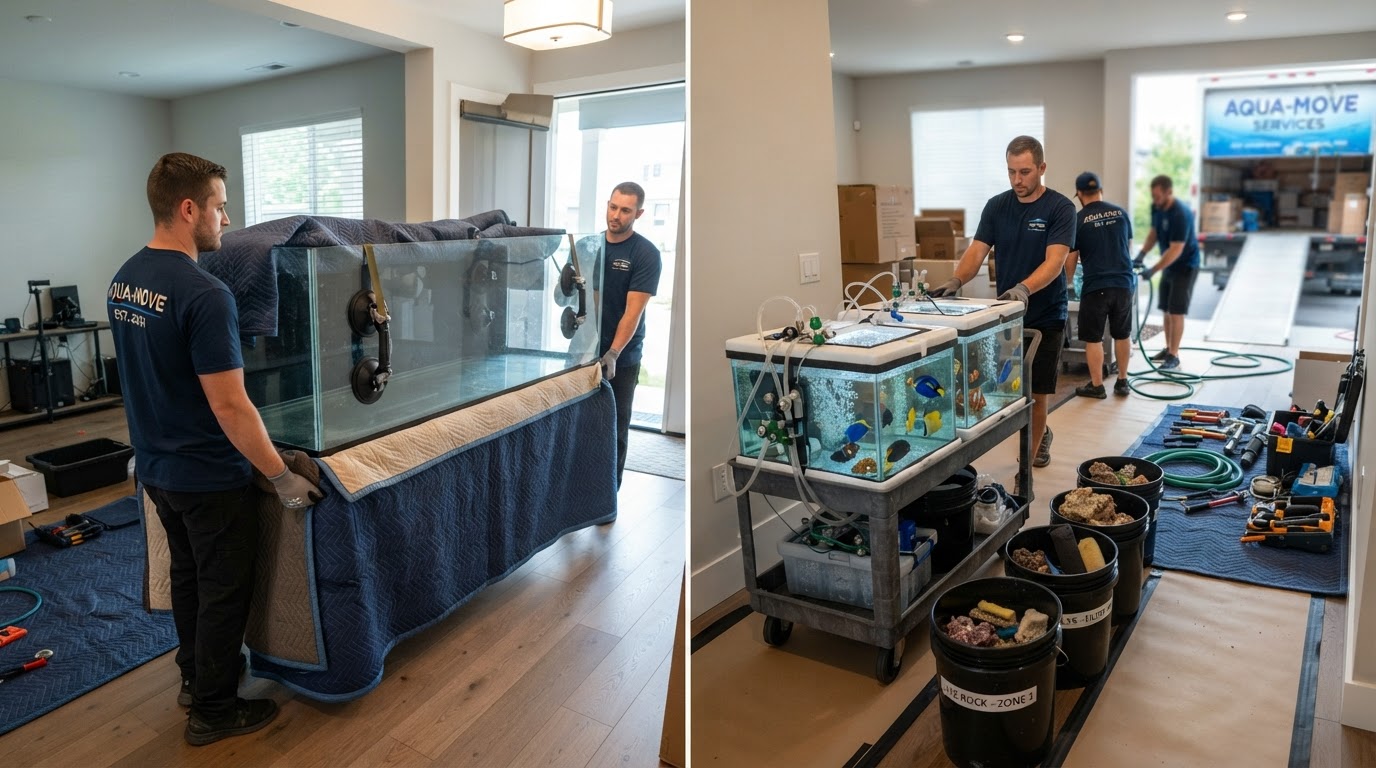
Moving an established aquarium is one of the highest-risk operations in the aquarium hobby. When homeowners attempt to move tanks themselves, they often drain the water into buckets, let biological filter bacteria dry out or suffocate, and experience total livestock crashes within 48 hours of reassembly. The difference between a successful move and a total loss is almost entirely in the logistics and the preparation.
Professional aquarium relocation specialists approach moves with clinical logistics. Fish and invertebrates are segregated into insulated, aerated containers with pure oxygen injection and battery-operated bubblers. The key is minimizing the time livestock spends in transit and maximizing the dissolved oxygen available during that time, because a sealed bag with no aeration has a finite survival window that depends on temperature and bioload.
Live rock and biological filter media are transported fully submerged in aged tank water to maintain beneficial nitrifying bacteria colonies. The moment filter media dries out, the bacteria die and the cycle restarts from zero, which means ammonia spikes that can kill every fish in the tank within days of the move. Keeping the media wet is the single most important factor in preserving the biological filter through a relocation.
Upon arrival at the destination, new water mixed with pre-warmed salinity matching the original parameters is introduced gradually to avoid osmotic shock. The tank is carefully leveled to prevent torsional stress on the bottom glass panel before full refill, because an uneven stand creates pressure points that can crack a panel weeks after the move appears successful.
Temperature matching is critical at every stage. Transport containers should be pre-warmed or insulated against the moving truck's ambient temperature, and the new water at the destination should be within one or two degrees of the livestock's accustomed range. A rapid temperature swing during transit is one of the most common causes of transport mortality, and it is entirely preventable with insulated containers and a little planning.
Timing matters as much as technique. A move planned for early morning in temperate weather gives the livestock the best chance of arriving stressed but alive, while a move attempted in the heat of a summer afternoon or the cold of a winter night adds thermal stress that can tip an already-stressed animal over the edge. Plan the move for the mildest part of the day and the most temperate season available.
Finally, expect a recovery period after the move. Even a perfectly executed relocation stresses the livestock, and the biological filter may take a week or more to reestablish full capacity. Test water daily for the first two weeks after the move, feed lightly, and keep an emergency water change ready in case ammonia or nitrite appears. Patience during this recovery window is what separates a successful move from a slow loss.
The cost of a professional aquarium relocation is measured against the value of the livestock it protects, and for a stocked reef or a mature display that value is substantial. A move that costs a few hundred dollars of professional labor protects thousands of dollars of coral and fish, and the investment in specialists who bring the right transport vats, insulated containers, and temperature-matched water is what separates a move the livestock survive from one they do not. The relocation that treats the livestock as cargo to be hauled rather than animals to be kept alive is the relocation that ends with a box of dead fish and a tank that needs to be restocked, and that outcome costs far more than the professional service that would have prevented it.
Need professional help with aquarium moving & relocation?
Connect with listed aquarium specialists serving residential and commercial facilities.