

How Often Should a Saltwater Aquarium Be Professionally Cleaned?
A practical guide to saltwater maintenance schedules, water changes, protein skimmer maintenance, and parameter stabilization for thriving marine fish and corals.
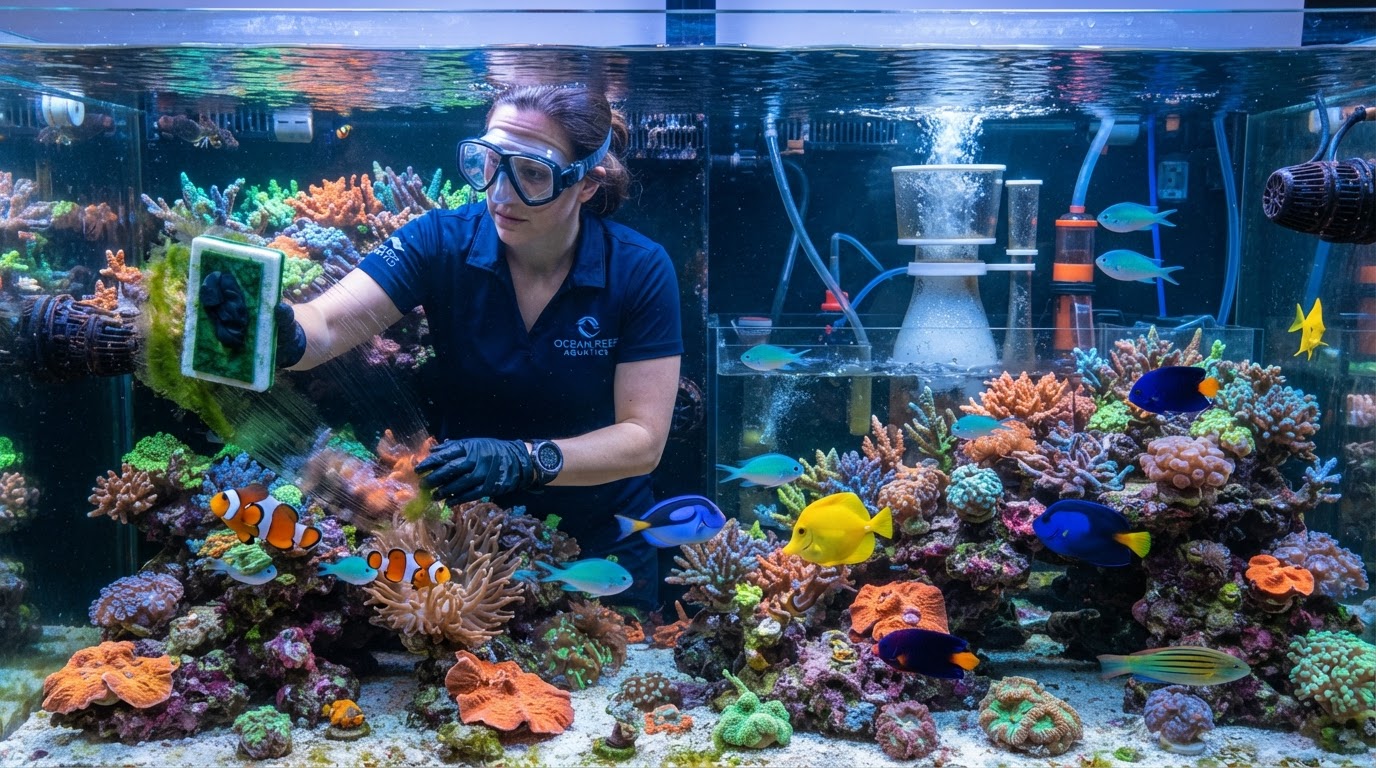
Maintaining a closed marine environment requires vigilance, precision chemistry, and consistent biological filtration. Unlike natural oceans where dilution is virtually infinite, an aquarium accumulates metabolic wastes, dissolved organics, and micro-nutrients that can quickly compromise animal health if neglected. The difference between a thriving reef and a recurring problem tank almost always comes down to the consistency and quality of the maintenance routine behind it.
For most established saltwater systems, a bi-weekly professional service visit provides the optimal balance between cost and biological stability. During a bi-weekly visit, technicians typically perform a 15% to 20% water exchange using temperature-matched, laboratory-purified RODI saltwater, wipe internal viewing panels, vacuum light detritus from the sandbed, and thoroughly scrub the protein skimmer collection cup and throat to restore foam fractionation efficiency.
Monthly water parameter audits should always accompany physical maintenance. Critical metrics include specific gravity (1.025-1.026), alkalinity (8.0-9.0 dKH for mixed reefs), calcium (420-450 ppm), magnesium (1350-1450 ppm), and nutrients like nitrate and phosphate. In high-density stony coral tanks, daily automated dosing supplemented by professional bi-weekly ICP-OES audits prevents catastrophic swings in carbonate hardness that can trigger tissue recession in sensitive corals.
The cleaning frequency that works for one tank may not work for another. A lightly stocked fish-only system with robust filtration may thrive on monthly visits, while a dense mixed reef with dozens of stony corals may need weekly attention to keep calcium and alkalinity from drifting. The right cadence is the one that keeps your parameters stable between visits, not the one that looks cheapest on a pricing sheet.
Equipment maintenance is just as important as water changes. Protein skimmer pumps lose efficiency as collection cups and impeller wells accumulate biofilm, return pumps see reduced flow as intake screens clog, and UV sterilizers lose germicidal output after roughly 8,000 hours of operation. A professional service visit that cleans the equipment — not just the glass — is what keeps the life support system running at factory output.
Temperature stability deserves as much attention as chemistry. A heater that sticks on or a chiller that trips off can swing water temperature by several degrees overnight, stressing marine livestock far more than a slight chemistry drift. A thorough service visit checks thermostat accuracy, verifies backup heating redundancy, and confirms that temperature monitoring is in place before a seasonal extreme exposes a weakness.
If you notice rapid micro-algae outbreaks, declining coral polyp extension, or water cloudiness between scheduled visits, an emergency inspection by a qualified aquatic maintenance specialist can prevent fish mortality and restore crystal clear water before delicate life support systems fail. These warning signs are the tank's way of telling you the routine needs to change — and catching them early is what separates a thriving display from a costly crash.
Finally, remember that consistency matters more than perfection. A saltwater aquarium cleaned on a reliable schedule — even if the parameters are not always textbook — will outperform one that hits perfect numbers occasionally but drifts between visits. Choose a cadence you can sustain, document every visit, and adjust the routine as the tank matures and its demands change over time.
Need professional help with saltwater & reef tank care?
Connect with listed aquarium specialists serving residential and commercial facilities.