

Saltwater Aquarium Maintenance: A Complete Guide
Water chemistry, equipment care, and cadence for saltwater aquarium maintenance that keeps marine livestock thriving.
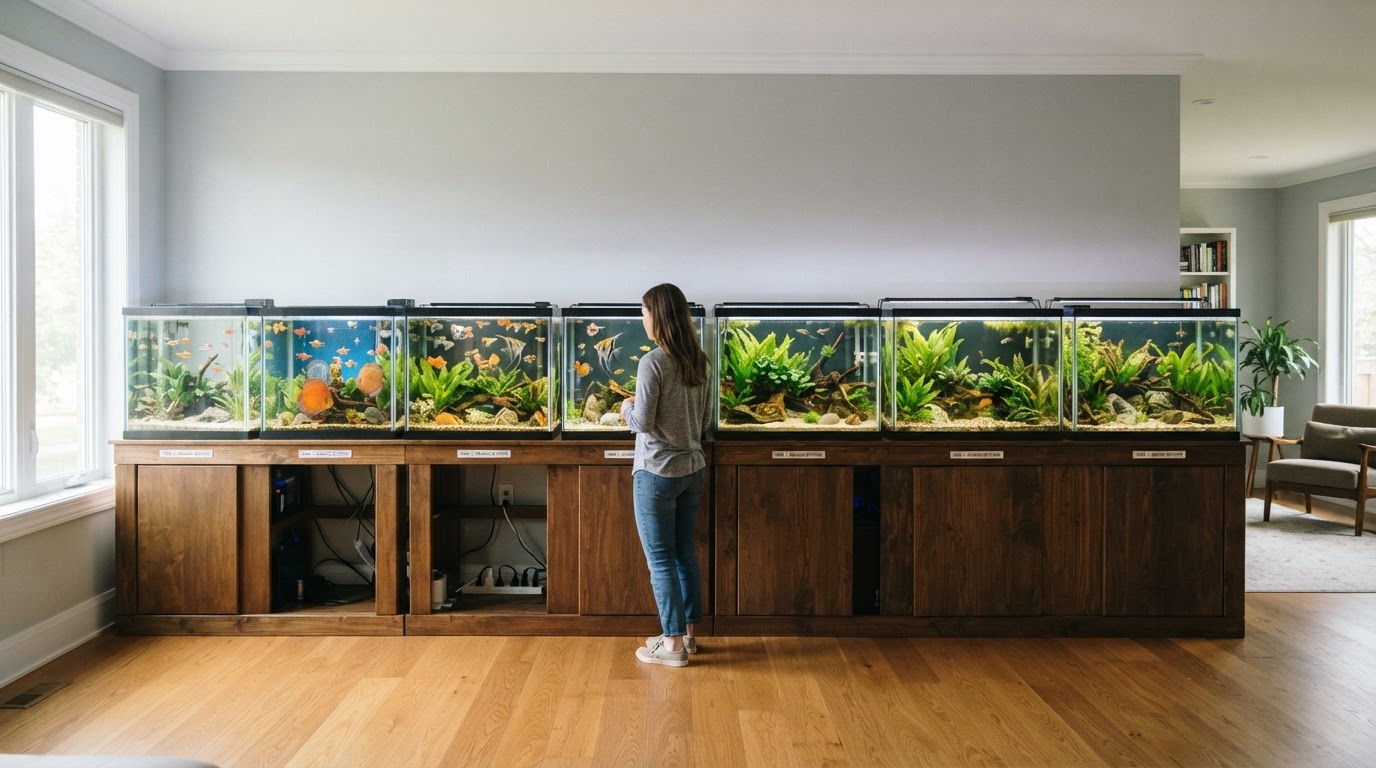
Saltwater aquarium maintenance is more demanding than freshwater care because marine livestock tolerates a narrower range of water chemistry. Salinity, alkalinity, calcium, magnesium, and trace elements all need to stay within tight bounds, and saltwater aquarium maintenance is the recurring work that keeps them there before a drift becomes a crash.
The core of saltwater aquarium maintenance is the salinity check at every visit, measured with a refractometer rather than a hydrometer for accuracy. Salinity should stay near 1.025 specific gravity or 35 parts per thousand, and a gradual drift — from evaporation topping off with fresh water, or from adding salt without mixing — stresses marine livestock long before it shows in their behavior, which is why measurement at every visit matters.
Alkalinity is the other backbone of saltwater aquarium maintenance, because it buffers pH and feeds the calcification that stony corals and many invertebrates depend on. Alkalinity should stay between 7 and 11 dKH depending on the system, and a drop below that range weakens coral skeletons and invites pH swings that stress the entire tank, which is why testing and dosing alkalinity is non-negotiable in a marine routine.
Calcium and magnesium belong in any reef-focused saltwater aquarium maintenance routine. Stony corals consume calcium to build their skeletons, and magnesium regulates how calcium and carbonate interact, so both need to be measured and replenished. A calcium reactor, dosing pump, or manual two-part dosing keeps these elements stable, and the method matters less than the consistency of measuring and replacing what the livestock consumes.
Equipment service is a bigger part of saltwater aquarium maintenance than freshwater care. Protein skimmers, return pumps, powerheads, UV sterilizers, reactors, and heaters all need regular cleaning and calibration, and a skimmer throat clogged with biofilm or a pump intake choked with detritus reduces the life support that marine livestock depends on. The equipment that keeps a reef alive is the equipment that needs the most attention.
Water changes in saltwater aquarium maintenance use pre-mixed saltwater that has been circulating for at least 24 hours to fully dissolve and stabilize, not freshly mixed water that can burn sensitive invertebrates. A 10–20% change every one to two weeks, using RODI water mixed with a quality salt, dilutes dissolved wastes and replenishes trace elements, and the patience of mixing ahead is what protects the livestock a rushed change would stress.
Documentation matters in saltwater aquarium maintenance because the parameters are too many to track by memory. A log of salinity, alkalinity, calcium, magnesium, nitrate, and temperature at each visit reveals trends — falling alkalinity, creeping nitrate, drifting salinity — that no single test would expose, and it gives any professional a head start on understanding the system. The log is what turns a series of visits into a managed, stable reef.
Finally, recognize that saltwater aquarium maintenance rewards consistency above all. The reef that is maintained on a schedule outlasts the one that is maintained when life allows, and the narrow tolerances of marine livestock make the cost of inconsistency far higher than in freshwater. The provider who arrives on schedule, tests every parameter, and documents the work is the one whose saltwater aquarium maintenance protects the investment in the livestock, the equipment, and the years it took to build the display.
Need professional help with saltwater & reef tank care?
Connect with listed aquarium specialists serving residential and commercial facilities.