

Removing Scratches from Acrylic Aquariums: Under-Water Buffing Secrets
How professional restorers use micro-abrasive wet sanding pads to remove deep acrylic hazing and scratches while the tank remains full of water.
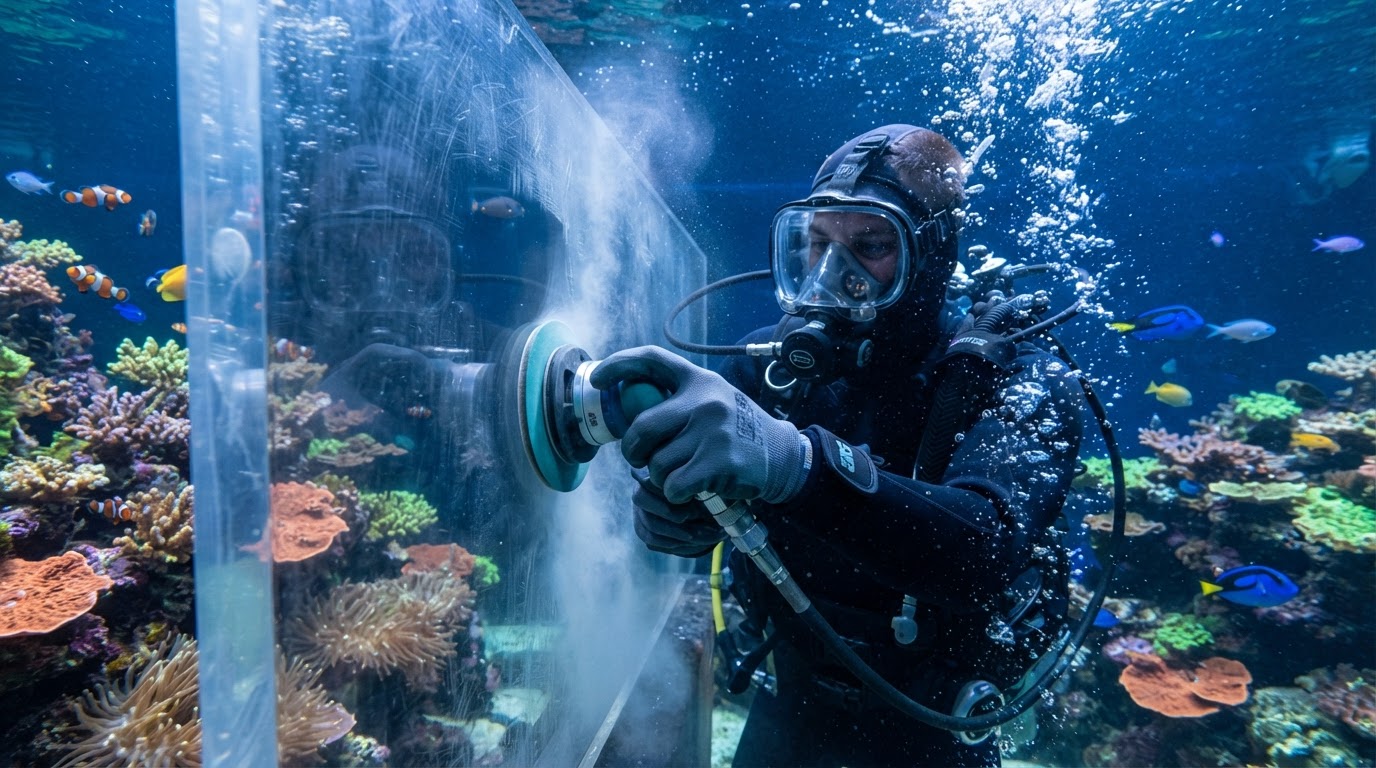
Acrylic aquariums offer superior clarity, thermal insulation, and seamless viewing panels compared to traditional glass, but they are far more susceptible to surface scratching from sand grains and abrasive cleaning pads. A scratch that would be invisible on glass is glaringly obvious on acrylic, and over years of use, a display panel can accumulate a haze of fine scratches that dull the viewing experience and frustrate the owner.
Fortunately, acrylic has a remarkable restorative property: it can be wet-sanded and polished back to optical perfection without draining the aquarium. Specialized wet-sanding kits utilize micro-mesh grits ranging from 1,500 down to 12,000 grit, and the process works by progressively removing the scratch through finer and finer abrasion until the surface is polished to a clarity that matches or exceeds the original factory finish.
Technicians work in smooth circular motions, feathering the repair area outward to avoid creating optical distortion or lenses in the acrylic. The goal is to remove the scratch uniformly across a wide enough area that the polished zone blends invisibly into the surrounding panel. A narrow repair creates a visible optical lens; a wide, feathered repair disappears.
The final buffing stages use inert polishing compounds completely safe for sensitive marine invertebrates. The compounds are designed to break down during buffing, leaving behind a surface that is smooth enough to resist future scratching while restoring the optical clarity that makes acrylic worth the premium in the first place. No toxins enter the water column during the process.
Depth matters. Light surface haze and shallow scratches can be polished out with the finer grits alone, but deep gouges that catch a fingernail require starting with the coarsest grit and working up through the full progression. Skipping grits saves time in the short run but leaves visible scratches that reappear under certain lighting angles, so a full progression is worth the patience.
Prevention is always cheaper than repair. Using dedicated acrylic-safe cleaning pads — never the same pad used on glass — and keeping sand away from the cleaning routine prevents most scratches before they happen. A magnetic scraper designed for glass will permanently haze an acrylic panel on the first pass, so the tools in the cleaning kit have to match the tank material.
Finally, recognize when a scratch is too deep to polish. A gouge that penetrates more than a millimeter into the panel may compromise structural integrity on a large tank, and no amount of polishing restores strength that has been removed. In those cases, a professional fabricator should evaluate whether the panel needs replacement rather than cosmetic repair, because a failed seam on a large acrylic tank is a catastrophic event.
The cost of professional acrylic restoration is modest compared to the cost of replacing a viewing panel, and for a large custom acrylic tank the panel can be one of the single most expensive components. A scratch that obscures the view or a haze that dulls the display devalues the entire investment, and the restoration that returns the panel to optical clarity is a fraction of the replacement cost. The provider who specializes in acrylic restoration brings the graded abrasives, the buffing compounds, and the technique that comes from doing the work repeatedly, and the difference between a professional polish and a DIY attempt is the difference between a restored panel and one that is worse than before the attempt, which is why the restoration is worth hiring rather than attempting without the right materials.
Need professional help with aquarium repair & restoration?
Connect with listed aquarium specialists serving residential and commercial facilities.