

Reef Tank Cleaning Services: What to Expect
How reef tank cleaning services handle sensitive corals, equipment, and water chemistry.
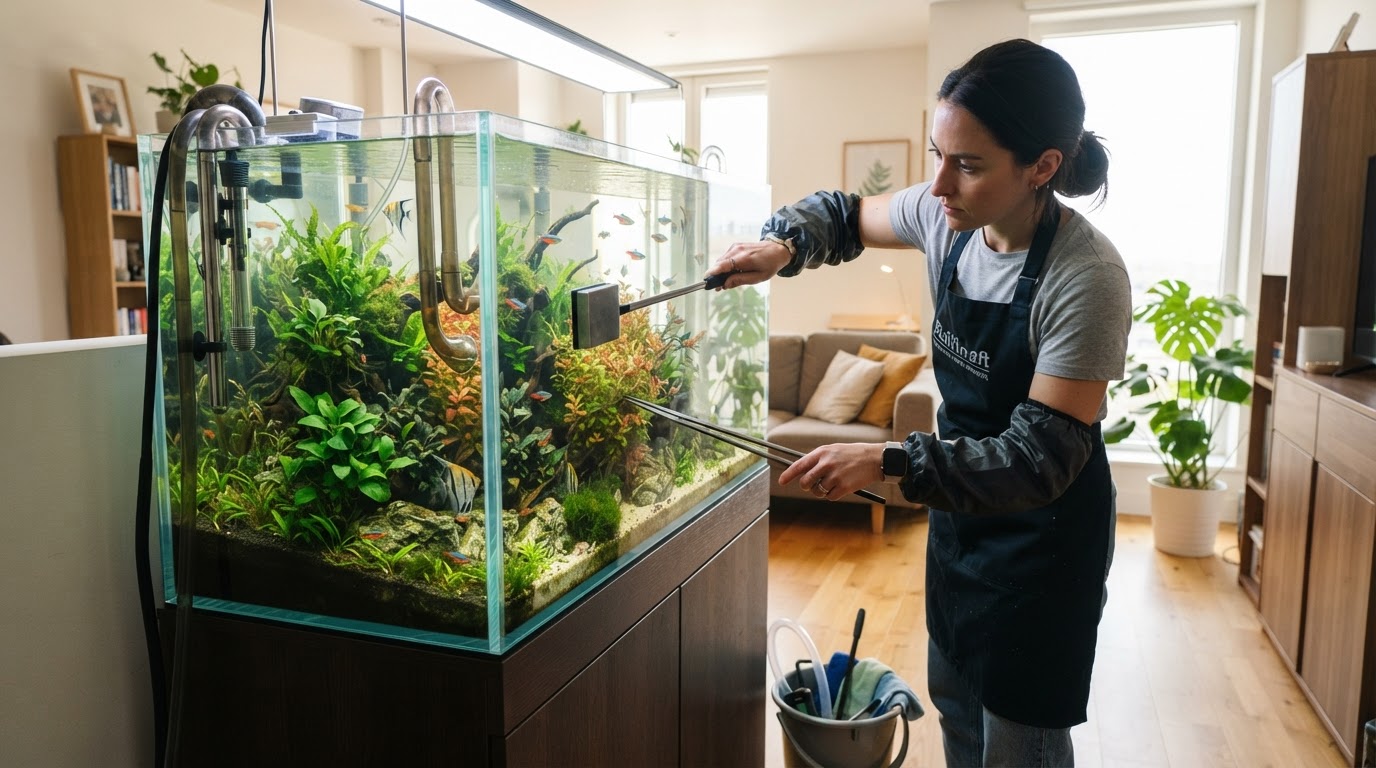
Reef tank cleaning services handle the most delicate work in aquarium care, because the coral and invertebrates in a reef are far more sensitive to handling and chemistry shifts than fish alone. A careless reef tank cleaning service can damage colonies that took years to grow, which is why the technique and the patience matter as much as the frequency.
The core of reef tank cleaning services is the controlled water change using pre-mixed saltwater that has been circulating for at least 24 hours, not a fresh mix that can burn sensitive coral polyps. Temperature matching prevents osmotic shock, and a gradual change — 10–20% at a time — dilutes dissolved wastes without destabilizing the chemistry the corals depend on, which is why the patience of mixing ahead is non-negotiable in reef work.
Equipment service is the largest part of reef tank cleaning services. Protein skimmer throats accumulate biofilm that reduces foam production, return pump intakes clog with detritus that drops flow, and dosing pumps can drift from their calibration. Cleaning and calibrating each of these restores the life support the coral depends on, and skipping the equipment to clean only the glass is reef care that serves the appearance, not the animals.
Coral and rock work is the part of reef tank cleaning services that freshwater does not require. Fragments knocked loose during cleaning can land on and irritate neighboring corals, and a careless hand can break a colony that took years to grow. The cleaning that works around the aquascape rather than through it is the cleaning that protects the investment in the livestock, and the technique is what separates a reef specialist from a generalist.
Algae control in reef tank cleaning services is about nutrient balance, not scraping. The nuisance algae that appears on the glass and rocks feeds on the nitrate and phosphate in the water, and the only permanent solution is keeping those nutrients low through water changes and careful feeding. A cleaning that scrapes algae without addressing the nutrients that feed it is a cycle that never ends, and it hides the chemistry problem the algae is signaling.
Testing after every reef tank cleaning service visit confirms the chemistry has not shifted from the water change or the equipment work. Salinity, alkalinity, calcium, magnesium, and temperature should be verified before the tank is left, because a cleaning that introduced a drift is worse than no cleaning at all. The test is the confirmation that the work helped rather than hurt, and it is the step most often skipped by a careless provider.
Documentation is what turns reef tank cleaning services from a series of visits into a managed system. A log of each parameter at each visit reveals trends — falling alkalinity, creeping nitrate, drifting salinity — that no single test would expose, and it gives any professional a head start on understanding the system. The reef that is managed with a record outlasts the one that is cleaned without one, and the log is the difference.
Finally, weigh the cost of reef tank cleaning services against the value of the coral it protects. A reef represents a significant investment in livestock, equipment, and time, and the cost of consistent care over a year is modest compared to the cost of a single crash that neglect causes. The reef tank cleaning services that test every parameter, dose what is consumed, and document the work are the ones that protect that investment, and the consistency is what makes the reef worth the years it takes to grow.
Need professional help with saltwater & reef tank care?
Connect with listed aquarium specialists serving residential and commercial facilities.